

It’s week Children with Diabetes feathered our book. The review of the book came highly recommended!!! Look at the website Http://www.childrenwithdiabetes.com/d_06_ao1.htm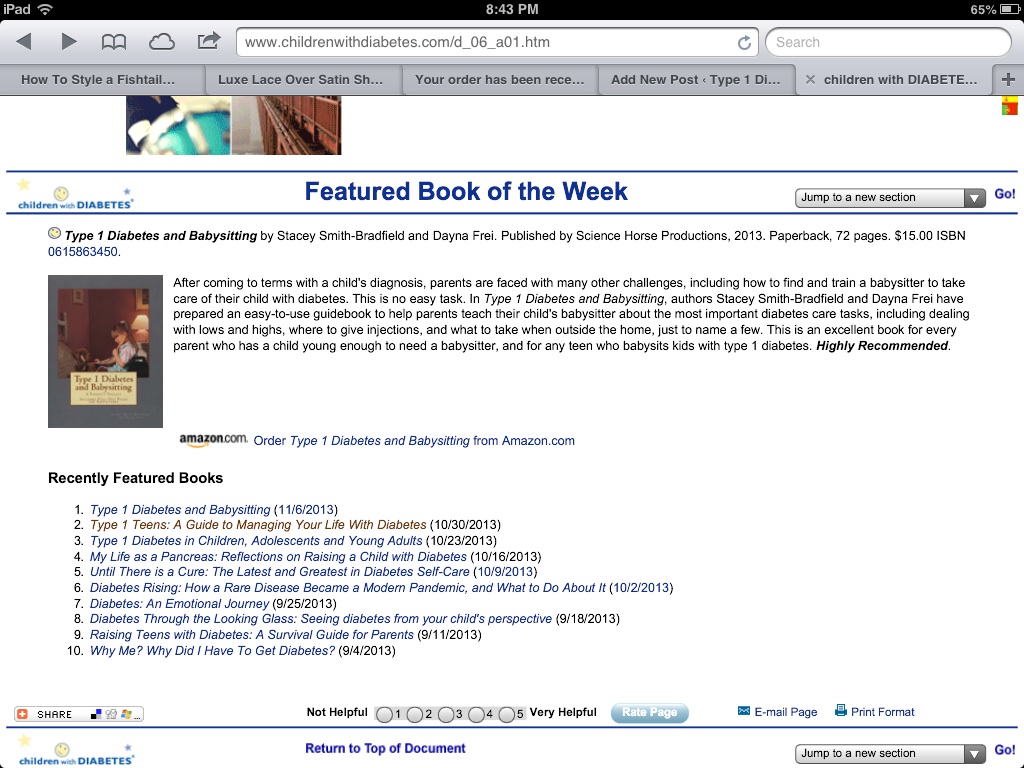
It’s week Children with Diabetes feathered our book. The review of the book came highly recommended!!! Look at the website Http://www.childrenwithdiabetes.com/d_06_ao1.htm
As a parent caring for a child type 1 diabetic you have likely been living day-to-day with blood sugars, carbohydrate counting, insulin, and then adjusting basal rates and insulin to carbohydrate ratios. (of course this is if your child is not a new diagnosed type 1). Then one day you realized you have a tween. You know the 9/10-13 years of age trying to be a bit more independent from you as a parent. Naturally they need to learn independence slowly. In a tweens life Peers become the ruling influence and the tween wants to make more of their own decisions. This is only the beginning as your child grows to adulthood. In a non diabetic life there is so much to consider. Diabetes then adds another layer for parents in raising a child to adulthood.
So how do you as a parent help your Type 1 child to navigate this need for some independence and stay safe with diabetes. As in a non diabetic kids, life and learning and not linear. You give a child room to be independent and then they have a life lesson and have consequences. So how to begin independence and type 1 diabetes? The first thing to do it is to understand where your own child is at with their type 1 diabetes comfort level. Does he or she know how to count carbohydrates and does correctly with insulin? Can he or she give a shot? Are they aware of their blood sugars and able to test? Finally, can you trust your child to do those things and not be caught up in “life”? If you can then begin by trusting them to go to a friend’s house or other youth activities without you.Then do you get a phone or no phone and what age so to promote being able to be more independent, and what age is a phone given? We use a phone because I can parent from afar and my son is able to gain more independence.
I feel any of the above only happens in small steps. What works for one family may not work for another because kids are so different. Each child’s learning can be vastly different, but some basic truths apply to all type 1 children. One such truths is self-care in relation to their diabetes. If this is satisfactory (able to test blood sugars, how to treat the blood sugar, and when to notify you as a parent) then I believe you let your child should be able to be away from the parent and grow gradually. For example we use our book, “Type 1 Diabetes and Babysitting: A Parent’s Toolkit” for my son to know what to do with his sugars. So when we are at a cross-road he looks up the basic steps and we always review it. If my son needs more training we discuss it with his educator.
With slow training, I believe your type 1 child will grow to an independent adult. It is all a learning process for us as parents and for our children. In the end as parents we don’t only have the responsibility to prepare them to be adults but to also teach our Type 1 Diabetics how to manage their disease in a healthy way so they are able to without our help as parents. The tween years can be fun and challenging at the same time. Having a clear plan to guide your type 1 child into adulthood will decrease stress for the whole family at this time in their lives.
Somehow in the last few years, I felt as if I could escape the crazy periods of type one diabetes. My son is all over with his sugars and keeping up with correcting and not allowing himself to go low. I know, I know, you’re thinking “boy are you in for a big surprise! Teens can be hard to manage at times!” I am waiting for the hammer to fall, but in the meantime I had planned to participate in blissful ignorance. And then it hit me as I am leaving the house to run an errand the other day. I realized my younger child needs to be taught how to help her brother (who has been a babysitter for me). Now Quincy is excellent at knowing if his sugars are not spot on, but what happens if he becomes distracted, or decides not to take care of something? I began to think of a time when I sat my 10-year-old down and discussed what to do with her. I think I assume she knows what to do because our house lives and breathes diabetes, highs and lows, in sickness and in health. So I started my mental list of what she does know: she knows to call 911, she knows to tell him to eat if he needs to and she knows how to call me when he is being completely unfair. But if he is having an insulin reaction, waiting for 911 may be too late.
This enticed me to make another list of what she needs to learn and how. She needs to learn how to give a glucagon shot, to test his blood sugar, what order does she need to take care of him and what he is like when he is low but still can argue (which he can do at a blood sugar of 20).
These thoughts lead to how to teach her. S he is only 10-years old. So my mental plan became:
In the above plan she still needs to know how to check his blood sugar and suspend his pump and be able to read his pump. But those are another teaching moment because teaching her everything makes me overwhelmed and I think it would make her overwhelmed. So then the plan will be to start with his book. I am a strong proponent of understanding the disease before dealing with the if, ands and buts. This is another reason our book works so well. Most people see the book and think my kid is beyond needing this, but I say anyone: siblings, other parents, grandparent, and the babysitter can read and use this book and that can be an advantage to having it.
When we started out writing our book as writers we knew how important a book about Type 1 diabetes and babysitting would be. We did not plan for interest so fast. Can you imagine our excitement when so many groups showed intersed quickly.
First, a few weeks ago I picked up a Colorado Springs Kids Magazine. I started to look through it for things to do during October and there was an article about Type 1 Diabetes. And At the end of the article the physician mentioned our book. To be fair I work in the same large medical group with Dr. Garscadden, a pediatrician. What I did not know is he was going to mention our book in his article! And thank you Colorado Springs Health Partners and Dr. Garscadden for your support! Secondly, JDRF reviews books twice a year for their online bookstore. They did contact us about a month ago to ask for a copy to review. So we sent on with fingers crossed! This week we found our book on their website! At JDRF’s bookstore you can find many helpful books for raising children with type 1 diabetes. Here is their website: http://jdrf.org/life-with-tid/bookstore/
Off to grandma and grandpa’s house we go….what goes in the diabetic bag (besides everything)?
The first few times Quincy went to grandma and grandpa’s I was a mess. He was excited! He got to play with grandpa and his flight simulator. Help grandma cook and play board games. The normalcy of childhood. The blessing to be able to find it with family. However, this did not take away my fear. I wasn’t a mess because I did not trust my in-laws. I did. But WHAT IF always lingered in my head. So we had the house type 1 child proofed. We hung carb counting cheat sheets and hypo cheat sheets in the kitchen cabinet. Quincy had his own supplies at their house, 4 ounce juices, easy to eat and will eat snacks, favorite foods, a glucometer, syringes. We even kept insulin there at times. All this to go down the street and to keep him safe.
Of course he did fine. Me on the other hand slept with my cell phone (now to have a type 1 and no cell phone…scary thought!). He had fun! He had a “normal” time with grandparents that love him and would sacrifice everything for him. His time with grandma and grandpa gave him memories that will stay with him forever. Funny how flying a plane on the computer and hanging out with some of your favorite people erases diabetic stresses for a child. I look back and the work was worth it. Yet, getting there could have been easier (at least hind sight). Now he goes out and about as a teenager with out much thought in preparing.
Even so my three ringed binder was always in the bag or on the counter (and still is). Everything was there, Doctors numbers, my number (like family would forget that!), what to do with lows or highs, calculations when he was on shots, You name it or we got it from the doctor or educator, it was in the book! Seems a little overboard now. But then I had no other answers on the how to. How do I make it easier for my son (who did not understand it fully) and how to make it easier for my in laws? Hopefully our book makes it easier for grandparents and extended family everywhere to get through that special time with their type 1 grandchild.
What is your story about extended family. Who has taken classes and done the work to care for your type 1 kiddo? What memories did you make with that family member with your type 1 child recently or in the past? How is that loved ones house type 1 child proofed?
Type 1 diabetic children and sleepovers
What was your childs first sleep over as a type 1 diabetic? How did it go with the other parents? How did you prepare for the sleepover?
My sons first sleepover was stressful for me as a parent and a professional. He was going over to a wonderful families house to stay the night just 4 blocks away. I had trained the mother and she said she felt very comfortable helping him give shots and counting carbohydrates. I felt comfortable leaving him. But only after we had talked and discussed it thoroughly! He had only had diabetes for 8 months or so. So my husband and I had some time to ourselves for a while. Then dinner time came. The mother had called me upset because she just couldn’t give him his shot. The idea of putting a needle in another person upset her so much. This was something she did not expect to feel. I went over and gave him his shot and then went the next morning to give him his shot. He did his own blood sugar testing. I was lucky because it was just down the street.
Once he had a pump he had an easier time with sleepovers. I still was very strict on where he could go. If he had a friend with physician parents they had an easier time keeping him overnight. They did get easier each time and as he became older.
I am curious about how this has worked for others. How did you teach families and parents? What materials did you use to teach these parents?
But mostly what is your story about the first sleepover and your type1 diabetic child?
Since we have been on the first theme. I began to think about that back to school experience. Type 1 diabetic child in school for the first time. The thought that I had to leave my child with school personnel. Let me paint the picture.
We were in a charter school for the better education. For those of you not in our area at the time that school was rate one of the top in the state. Quincy needed the challenge (or he took things apart and did experiments to learn about things!!) that this school provided. The caveat, they did not take kids they did not want. So those kids on 504 or IEP or ILPs did not make it into the school. But once you were there they could not kick you out. The up side to this there was a full time RN at the school. No school aid that took care of my son. I thought all was going to be well. Because as an NP the next best thing was a nurse. I felt better about him going to school.
However, the school isolated him, the nurse fought me on what the orders were for his shots, she did not even understand what Type 1 diabetes was and what they needed. She openly admitted to not understanding and was trying to learn. I had teachers aids tell me they did not have time in the instruction to deal with type 1 diabetes!
The fortunate thing was Quincy was oblivious to this. He was always excited about school. He did have issues with his sugars. And more than once he did not get a shot the nurse should have given him. My anxiety increased about leaving him anywhere. I could not trust the nurse to care for my kiddo how was anyone going to care for him the way I could.
In the end and after writing my own 504 plan but not getting it to the teachers (the school just needed it on file for my son incase the state looked into it!) We moved schools.
The new school was what we should have had in the beginning. Diabetic care was always first.
Type 1 always calls for a parent to advocate. But how do you do that without guidance of what is wrong. Places I that would have helped me was at the very least my diabetic educator (but I never asked for what I thought was normal)!
This is another book for another day. Type 1 diabetes and the basics for school days. There are so many resources out there for this and I think new diabetic parents need to be on top of these resources. Type 1 Diabetes and the specifics of your kiddo.
What was your Type 1 back to school experience?
Do you remember that day of your kid being diagnosed with Type 1 Diabetes? Overwhelming, scared, not sure how to keep your kid alive tomorrow! I remember. It was an evening and we went to urgent care because he did not feel good and he was urinating all the time. The NP that saw us happened to be one of my old professors from college. She told me we needed to go to the ER because he has Diabetes. I sucked up my emotions to drive to the emergency room. I replayed in my mind the last few months…what did I miss? I am a nurse pratitioner I sould have seen it coming but why didn’t I? Those are haunting questions that I could never answer. And sometimes we don’t have those answers.
When we got to the ER my husband showed up and I went to the bathroom and cried for what seemed like an hour. What no one knew is I saw patients each week in dialysis from not taking care of their diabetes, very ill sick patients. Type 1 and my child. No way. NOT ME!!! Then realizing I am now the parent how am I going to keep him alive and never go to dialysis.
The days that follow were a blur. From the educator to the nurses I never left my childs side. Now how am I going to go back to work and let someone else watch my child. I did not think I could take care of him well who else was going to help take care of him. While I was a mess, my son took it in stride. He did not like the shots (but who does) and he faced it like a soilder. He went about what he needed to do. He can educate anyone what is exactly occuring in his body than anyone around him incluiding me. With the weight of his diabetes and any little thing could kill him, training the nurse at the school even, trying to teach family, and trying to learn it as a parent made life in general overwhelming. No wonder it took 3 years to really go out and enjoy a date with my husband or have a sitter in charge of him. Type 1 can rule your life and the entire family. If you are on shots, meals have to be a certain times. If on a pumps, you are always adjusting the basal rates or sensitivities or ratios.
As I became more comfortable leaving Quincy with others it was only because I trusted him and trusted he knew his body. Not because I had a good method to teach a sitter. Type 1 ruled my life every minute of every day. Now that he is a teenager I don’t worry about leaving him. I do have a consistent sitter, but more for my younger child than him (she does help him often). He watches my younger child more often than anyone else. No resources were avaible to help train the sitter for my son so we made one.
What I want to know is how other parents dealt with diagnosis day of Type 1 diabetes? What was that like? Where you able to keep normalcy or did your world suddenly get small? If it got small when did you open up and allow it to enlarge?
Type 1 Diabetes can overwhelm and rule your life until you feel you can rule it…when does that really occur though.
http://www.momseveryday.com/video?videoid=2674483
Here is our 2 minute video clip about our book! We were so lucky to have been able to go on and discuss Type 1 diabetes and babysitting. It was all very exciting! I am a behind the scenes kind of gal (so slightly nervous) and Dayna appeared so comfortable (at least on the outside!).
We want to thank KKTV and CSHP for setting up this interview.
Check it out. We talk very briefly about the book and how it evolved! Type 1 moms developing this babysitting tool.

Start of the Denver JDRF walk
Well here it is today. Fundraising and meeting tons of new families and people! Getting your name out into the world is hard work! But worth every bit. Things we did note today that I think is important:
1. Hiring any babysitter is scary when your most precious cargo can be seriously hurt! While having a type 1 sitter is easier, simply because the sitter knows the disease, it is not always practical. That is how our book helps! It is designed specifically for your child while helping a non-diabetic understand your child.
2. So many teenagers with type 1 are starting up babysitting! Such a wonderful need! I still think this book is important. Your child is yours and the teenage type 1 kiddo understands the ins and outs, but needs specifics on your very individual special child.
3. Grandparents can utilize this book! I met many today that have taken a grand parenting class but wanted the book for the type 1 in their life.

Dayna at our booth!
We all have our reasons for needing this or not wanting to leave our kids with just anyone. Just anyone can be scary. What if we found someone who is not type 1 but learned how to love and care for our type 1 with ease? Our fear as parents may lessen and life can be a bit more normal!
There are sample pages up on the blog and Amazon lets you look through some of the book. Take a peek.
If you are in the Colorado Front Range we will be at the Colorado Springs Walk at America the Beautiful Park next Saturday and we will be on the local KKTV news September 11 at 9 am. Check us out. If you see us around we do have books on hand for $15.
See everyone next week.
 type1toolkits.com